
ABOUT THE DEPARTMENT
The Department of English stands as a vibrant center of literature, language, and expression – committed to nurturing clarity of thought, eloquence of speech, and depth of understanding in students of Loyola. It cultivates an academic environment that inspires inquiry, creativity, and intellectual growth, while being grounded in the mastery of the essential skills of communication – Listening, Speaking, Reading, Writing, Grammar, and Vocabulary.
The literature facet of the Department is a space where language breathes, imaginations unfold, and critical minds are shaped. Through diverse literary papers, students are invited to explore the worlds of poetry and prose, engaging deeply with texts that illuminate human experience across time and culture. Literature here is not merely read, but lived – analysed, performed, and reimagined.
To complement this literary foundation, the Department also offers a robust suite of language-based courses designed to refine communication and professional fluency. These include General English, Business English, Academic Writing, Communicative Competence, Soft Skills, Career Skills, and Communication Skills. Each course is structured to enhance linguistic precision and global readiness – equipping students with the competence and confidence required for promising career opportunities and advanced studies abroad.
In its commitment to holistic development, the Department fosters platforms for intellectual and creative expression. Literary events, featuring workshops, competitions, and staged theatrical productions, served as a testament to the Department’s dedication to cultivating both scholarly excellence and artistic talent.
Guided by a blend of tradition and innovation, the Department continues to shape learners into confident communicators and global citizens, ready to meet the world with insight, grace, and purpose.


ACADEMICS
The Department of English caters to all the programs in the college. English is a compulsory subject offered at the Undergraduate and the Post-graduate level to all the students.
Undergraduate Courses
English is offered as an Ability Enhancement Compulsory Course (AECC) to the students of First and Second semesters in all programs at the undergraduate level. Three common courses are offered to students of different streams.
General English: It is offered to the students from the
- School of Informatics,
- School of Science, Food Technology and Nutrition,
- School of Agriculture, and
- School of Arts and Humanities
The General English course is taught with the objective of enhancing the learners’ English communication skills by giving adequate exposure in reading, writing, listening and speaking skills and the related sub-skills. The curriculum covers short pieces of literature that provide the groundwork for study of language. Each unit has components of literature, textual analysis of the literary piece, grammar, vocabulary enhancement and writing skills. With this structure, each unit enables the learners to improve their language proficiency for interpersonal and professional domains. The course aims to enhance the linguistic competence of students to improve their communication skills and to elevate their reception and understanding of English language-based subjects that they study as a part of their undergraduate program and in their professional life.
Business English: This course is offered to the students of the
- School of Commerce and
- School of Management
Business English in our college degree programs is not merely advantageous—it is essential in today’s interconnected global economy. By equipping students with specialized communication skills, our curriculum centered around Business English not only elevates learners’ linguistic competence but also prepares them to thrive professionally in diverse, cross-cultural environments. A central component of Business English is to sharpen the written and oral communication tailored to corporate contexts. The objectives of the Business English course are to make learners significantly improve their ability to engage in effective business communication. It aims to help students meet a wider range of writing demands in business context to suit a varied clientele. Further, it aims to develop collaborative group communication and writing skills, preparing students to navigate global business etiquette, diverse communication norms, and cross‑cultural negotiations.
Academic Writing: This course is offered to the students of the
- Department of B.A. (Psychology, English and Journalism) and
- Department of B.A. (Mass Communication)
This course is aimed at honing the writing skills of students to cater specially to academic needs. It is designed to help Indian students with intermediate/advanced English skills. Students who are non-native speakers of English often find the written demands of their courses very challenging. In addition to the vocabulary of academic English they need to learn new ways of formal writing. Subject facilitators are often concerned by the lack of critical thinking skills, and mention students’ failure to answer the specific question and their inability to develop answers logically. Issues around vocabulary, plagiarism and are significant additional worries. The course sets out to address these problems directly.
POST GRADUATE COURSES
The Department of English, Loyola Academy offers comprehensive courses in Communicative Competence and Soft Skills, designed to empower students from diverse academic backgrounds with the tools necessary for effective and impactful communication. Recognising that strong communication is a cornerstone of academic success and professional growth, the program integrates language learning with real-world application.
We specifically tailor our instruction to postgraduate students across various streams, including:
Computer Applications,
Data Science,
Biotechnology,
Food Technology and Management,
Food Science and Nutrition,
Organic Chemistry,
and Business Administration,
ensuring relevance to their unique academic and professional contexts.
These learner-centric courses emphasise skill development in presentation techniques, group discussions, business writing, corporate etiquette, and interview readiness. A strong focus is placed on helping students navigate the nuances of Indian English while aligning with global standards of usage. By blending theoretical understanding with practical training, the department ensures that students not only learn the mechanics of language but also develop the confidence to express themselves with clarity, precision, and poise in various professional and academic settings.
What sets this program apart is its interdisciplinary relevance and adaptability to the specific needs of these postgraduate streams.
Whether students are preparing formal documents, engaging in team-based projects, or participating in professional interviews, they graduate with the communication acumen and soft skills necessary to lead, collaborate, and succeed in dynamic, multilingual, and multicultural environments.
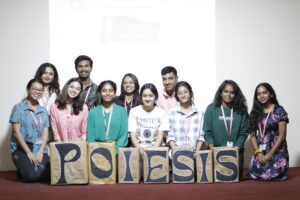
POIESIS: MAKE IT ENGLISH!
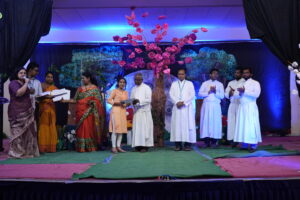
The Department of English successfully organized a two-day literary event,
POIESIS: MAKE IT ENGLISH!
on 11-12 March 2025,
bringing together students and distinguished guests for an enriching experience of learning, creativity, and performance.
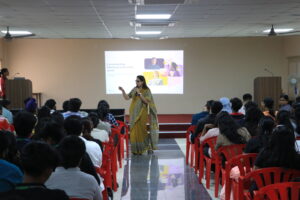
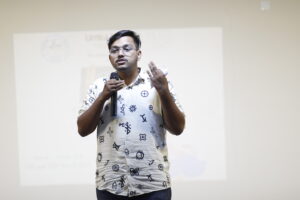
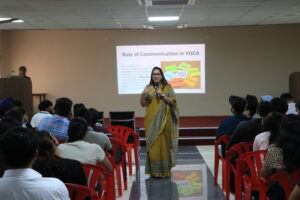
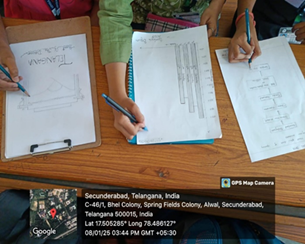
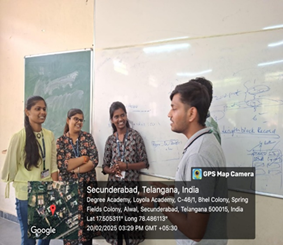
The inaugural day focused exclusively on interactive workshops on Communication Skills, designed for registered participants from various departments of the college. The first session on writing techniques was conducted by Dr. Sheba Victor and Mr. Simon Peter, both from the English and Foreign Languages University, Hyderabad. The attendees worked on thoughtfully designed worksheets enabling them to put their newly acquired learning to immediate practice, making the session both practical and engaging. As a result, what could have been a strictly theoretical lecture, transformed into a dynamic, hands‑on experience. Participants exchanged ideas in real time, revised drafts on the spot, and offered peer feedback – creating an energized environment buzzing with creativity.
Following a refreshingly interactive start, the second session conducted by Ms. Michelle Pepper, a soft skills and personality trainer, tackled the intricate concepts of ambiguity and uncertainty in communication. Led by an expert facilitator, the session featured a series of purposefully designed activities and exercises. This playful yet profound approach taught them key lessons in strategic communication – how to choose words consciously, listen with purpose, interpret underlying messages, and make decisions when information is incomplete. By the end of the workshop, participants walked away with a clearer awareness of how to convey nuance, how to sidestep misinterpretation, and how to sharpen both their expressive and interpretive abilities.
The second day marked a significant expansion of the event’s scope, transforming it into a thriving inter‑college festival. Students from Loyola Academy and various other colleges flooded the venue, eager to showcase their talents and learn from one another.
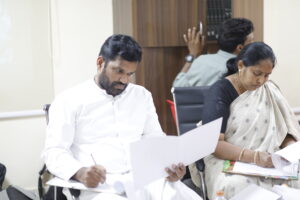
A highlight of the morning was OFF THE CUFF, the Extempore Speech Competition, where contestants were prompted to deliver spontaneous speeches on diverse, thought‑provoking topics, which illuminated their mental agility and composure under pressure. Judges and audience members alike were impressed by how participants navigated unexpected themes with clarity and eloquence.
In tandem, PAINT-THE PLOT, the Book‑Cover‑Design contest provided a striking visual and conceptual contrast. Chitra Banerjee Divakaruni’s well acclaimed novel, The Palace of Illusions was the book that the participants were expected to create the cover for. Talented participants interpreted literary themes of the novel through art, blending creativity with critical analysis. Original imagery, imaginative typography, and conceptual depth all came together in works that drew both admiration and curiosity from the crowd.
Metamorphosis: the Performance Poetry Competition had the audience spell bound as impassioned participants performed their poems on the theme of transitions in life. Budding poet performers laid bare their feelings and ideas through powerful imagery, eloquence and histrionics. Thundering applause followed some mesmerizing performances.
Twist- the- Tale, the story retelling competition had the highest number of participants, showcasing the youth’s desire and impulse to rewrite the olden myths and legends with a modern view. Participants were assigned to twist the age-old Snow-white fairytale, making it relevant for contemporary readers. Participants let loose their critical, analytical and imaginative faculties to rewrite the fairytale and came up with amazing renditions of the narrative.
Each competition showcased remarkable originality, intellectual depth, and stage presence. Winners received cash prizes along with enthusiastic recognition – from certificates to trophies – and even quieter acknowledgements such as peer applause and encouraging feedback. Beyond awards, the true victory lay in the bonds formed, ideas exchanged, and horizons broadened by interaction with talented young minds from different institutions.
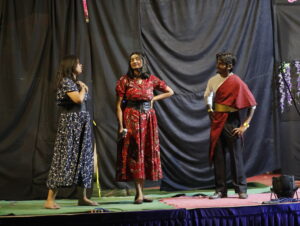
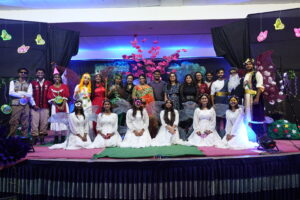
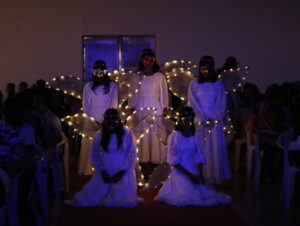
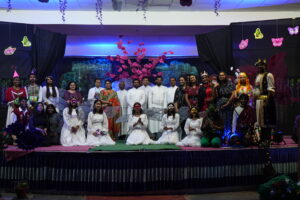
The culmination of the literary festival was a stunning theatrical performance by Loyola Academy students: William Shakespeare’s comedic masterpiece, A Midsummer Night’s Dream. The production exceeded expectations in every regard – meticulous set designs, imaginative direction, nuanced character portrayals, and vocal clarity. Each actor brought Shakespeare’s beloved characters – Helena, Hermia, Lysander, Demetrius, Puck – to life with charm, wit, and emotional resonance.
The audience watched, captivated by moonlit forest scenes, hilarious misunderstandings, and spellbinding fairy magic. As the final curtain descended, the room erupted in thunderous applause and a well‑deserved standing ovation – a triumphant seal on an evening that celebrated artistry and collective accomplishment.
Over the course of two exceptional days, Loyola Academy’s Department of English forged more than just individual workshops or performances. They created a holistic cultural event – one that fostered collaboration, intellectual curiosity, and artistic expression. Students and guests alike engaged in mutual learning, artistic experimentation, and meaningful dialogue. This literary event served as a powerful affirmation of Loyola Academy’s enduring commitment to academic excellence and its continued support for the literary and performing arts.
Loyola Academy is poised to further elevate its cultural legacy and continue to nurture future generations of writers, speakers, artists, and performers.