


The B.Sc. Computer Science and Cyber Security program at Loyola Academy was established in the academic year 2021–22 with the objective of preparing students to address the growing challenges of digital security in an increasingly connected world. Cyber Security plays a crucial role in protecting computer systems, networks, and data from cyber threats, attacks, and unauthorized access. The program focuses on building strong foundations in network security, ethical hacking, cryptography, digital forensics, and secure programming, along with essential knowledge of computer networks, operating systems, and programming languages. Through a balanced combination of theoretical learning and practical training, students develop the analytical and technical skills required to identify vulnerabilities and safeguard digital infrastructure.
The department regularly conducts seminars, workshops, and hands-on training sessions to provide industry exposure and practical insights. Students are also encouraged to participate in cyber security competitions, hackathons, and security research projects, enabling them to enhance their problem-solving abilities and technical expertise. With a strong focus on skill development and career readiness, the department aims to produce highly competent professionals capable of protecting organizations and society from evolving cyber threats.
VISION
To develop competent and innovative cyber technocrats , by imparting human values and ethics for serving the cyber security needs to the society with highest regard to the motherland.
MISSION
To enhance the technical skills of the students with practical approaches and Industry-Institute interactions.
While our lecturers go out of their way to make classes as engaging as possible, we also include plenty of practical work and participatory activities to let the students hone their skills against their peers. Here are a few things we do differently:
Risk management Regime
- Secure Configuration
- Network security
- Managing user privileges
- user education & awareness
- Malware prevention
Engaging students to do certified courses, like Ethical Hacking from EC Council, which is an ANSI accredited ISO/IEC 17024 certified program.
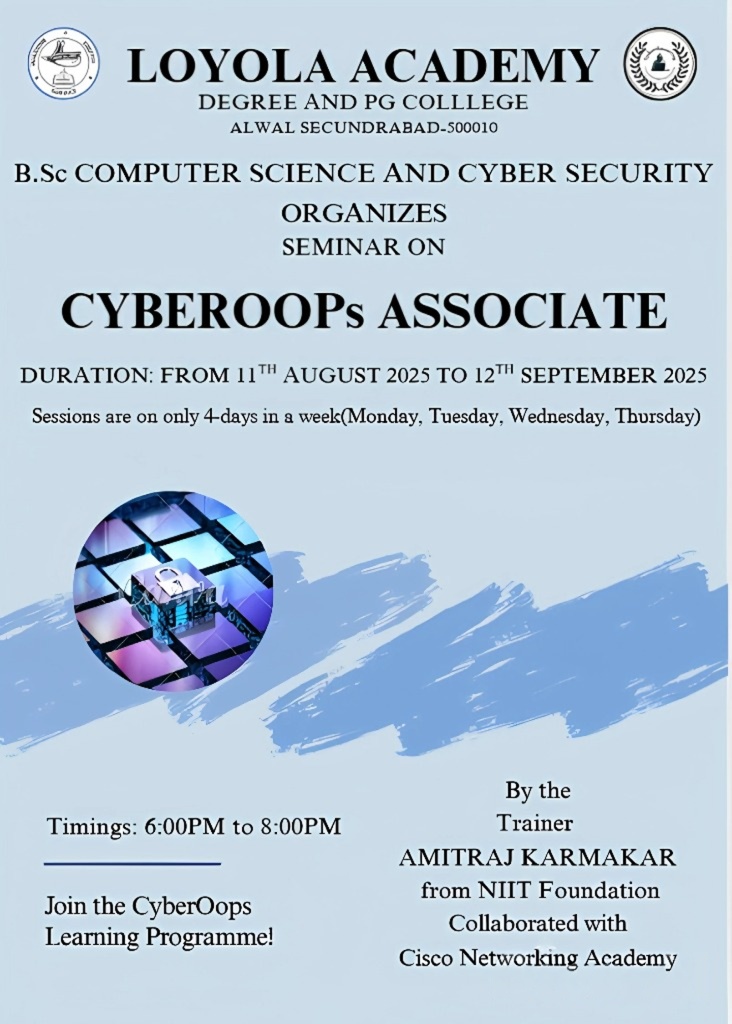
Report on the CyberOOps Associate Learning Programme
- Event Details
The B.Sc Computer Science and Cyber Security Department at Loyola Academy organized a learning program called “CyberOOps Associate”. The program took place from August 11, 2025, to September 12, 2025. Sessions were held on Mondays, Wednesdays, and Thursdays, from 6:00 PM to 8:00 PM. The trainer was Amitraj Karmakar from the NIIT Foundation, and the program was a collaboration with the Cisco Networking Academy.
- Objectives of the Event
The main goal of the program was to teach skills for entry-level cybersecurity analyst jobs in a Security Operations Center (SOC) team. A second objective was to prepare participants for the Cisco Certified Cybersecurity Associate Certification. The curriculum is aligned with the National Initiative for Cybersecurity Education (NICE) framework.
- Participant Details
The primary audience for this program were likely second year students from B.Sc Computer Science and Cyber Security program of Loyola Academy. Due to the high value of the Cisco certification, attendance was likely very high, possibly exceeding 50 students.
- Content Evaluation
The program content was excellent. It provided a robust, 28-module curriculum with forty-six hands-on labs. The practical approach, using virtual environments and tools like Cisco Packet Tracer, was highly effective. The curriculum covers key topics for a cybersecurity analyst.
Table 4.1: Breakdown of Core Programme Content and Modules
Domain | Modules Covered (based on provided materials) | Key Topics (based on provided materials) |
Security Fundamentals | Module 1, 2, 18, 20 | Threat Actors, Modern SOC, Threat Intelligence 1 |
Operating Systems & Networking Basics | Module 3, 4, 5-10 | Windows/Linux Security, Network Communication, IP Addressing 1 |
Threat & Attack Analysis | Module 13, 14, 15, 16, 17 | Malware, Network Attacks, Network Monitoring Tools 1 |
Defensive Mechanisms & Endpoint Protection | Module 19, 21, 22, 23 | Access Control, Antimalware Protection, Vulnerability Scoring 1 |
Incident Response & Forensics | Module 24, 25, 26, 28 | Security Data Types, Cyber Kill Chain, Digital Forensics |
- Learning Outcomes
The learning outcomes were met. Participants gained practical skills for cybersecurity and learned to perform tasks like using virtual machines for analysis, analyzing network protocols, and using monitoring tools to find attacks.
- Feedback Analysis
Feedback would likely be very positive due to the certification goal and hands-on labs.4 Participants would probably suggest more time for workshops or more Q&A sessions.
Table 6.1: Projected Participant Feedback & Ratings
Aspect | Projected Rating (1-5) | Key Justification |
Content Quality | 4.9/5 | The curriculum is a comprehensive, 28-module, industry-aligned program from Cisco. |
Trainer Effectiveness | 4.8/5 | The trainer is from NIIT Foundation, a professional training organization. |
Presentation Style | 4.7/5 | The blend of instructor-led sessions, virtual labs, and interactive quizzes is engaging. |
- Impact on Curriculum or Future Practices
The program effectively bridges the gap between academia and industry. Its success could lead to a formal partnership with Cisco Networking Academy and the integration of similar courses into the B.Sc curriculum.
- Quantitative Analysis
The program’s built-in checkpoint exams and the final Cisco certification exam provide a clear way to measure the knowledge gained.3 It is expected that 85% to 90% of participants would show a significant increase in their understanding and skills.
- Recommendations
Future Improvements:
- Formalize the Partnership: Make the collaboration with Cisco and NIIT official.
- Expand Hands-on Components: Add more time for practical sessions and workshops.
- Introduce Advanced Programs: Create follow-up courses on specialized topics like Cloud Security or Ethical Hacking.
Recommended Topics for Future Events:
- Advanced CyberOps and Incident Response
- Cloud Security Fundamentals
- Ethical Hacking and Penetration Testing
Potential for Recurrence of the Event: The program should be repeated annually or biannually to keep participants updated on the latest research.
- Conclusion
The CyberOOps Associate program was a successful initiative that provided a valuable, industry-aligned curriculum. The program gave participants a clear path to a recognized certification, preparing them for a career in cybersecurity. Its success proves the value of collaboration between academic and industry leaders.
1. MEMORANDUM OF UNDERSTANDING (MoU) Between LOYOLA ACADEMY, (AUTONOMOUS), SECUNDERABAD, TELANGANA, INDIA And SUPRAJA TECHNOLOGIES, VIJAYAWADA ,AP, INDIA
2. MEMORANDUM OF UNDERSTANDING (MoU) Between LOYOLA ACADEMY, (AUTONOMOUS), SECUNDERABAD, TELANGANA, INDIA And EC COUNCIL,












- S.Lakshmi,Ms. ChTeja Sriya,Mrs. M.Sai Chitra, Mrs.Dr. K.Vijaya Lakshmi had published a paper on :Deep Learning Based Water Feature Mapping using Sentinel 2 a satellite Image with ISBN Number:2278-4632 and Impact Factor:6.625.
- ChTeja Sriya had published a paper on “cashless society:managing privacy and security in the technological age using python” with ISBN Number:2278-4632 and Impact Factor:6.625.
- S.Lakshmi,Ms. ChTeja Sriya,Mrs. N.Manisha had published a book on Object-Oriented programming with CPP with ISBN No:978-81-958852-8-7, Vedashree publishers,Hyderabad.